Paternity leave in 2026: what fathers need to know
Paternity leave: a subject not talked about enough
Why it's important to talk about it
When you become a parent, you often hear about maternity leave, breastfeeding, the post-partum period, the mental burden...
But paternity leave remains almost invisible in conversation. As if it were a mere administrative detail administrative detail, when in reality it makes a huge difference to a family.
And between us moms, we know all too well just how upsetting the first few days can be. That moment when everything changes, when you discover your baby, when you try to recover physically and emotionally... and when you wish you weren't alone to deal with it all.
So today, we're talking about paternity leave.
Because it matters.
Because it should count even more.
And because we all (moms, dads and babies) deserve a smoother start to life.

Paternity leave in France: a right that has (finally) evolved
Where we came from, where we are now
Not so long ago, fathers only had three days at birth. Three days. Time to say hello to baby and get back to work.
It was not until 2002 for real paternity leave to be introduced.
Then, in 2021, a major breakthrough: as of July 1, 2021, paternity leave for the birth of a child has been extended to 25 calendar days (or 32 days in the case of multiple births). info.gouv.fr+2Economy and Finance+2
According to the Department of Labor: these 25 days are divided into two parts: 4 mandatory days immediately following the birth, followed by 21 days (or 28 in the case of multiple births) to be taken within 6 months, which may be split into separate periods. Ministry of Labor
If the child is admitted to the hospital immediately after birth, the mandatory 4-day stay may be extended up to 30 days. Tissot Publishing
And the law clearly stipulates that this leave must be taken within six months of the birth. Department of Labor
How are things elsewhere? We compared
Looking elsewhere: what other countries are doing
Because the reality is that some countries have long understood that a father's presence is essential. And others... not so much.
Here's a simple, meaningful table (with comparative contexts):
|
Country |
Duration/typical paternity leave |
Interesting feature |
|
France |
25 days (32 if multiple births) |
Mandatory portion + portion to be taken within 6 months |
|
Sweden |
90 days reserved for fathers out of 480 days of parental leave |
Incentive for the father to take his share, compensation close to the salary |
|
Spain |
16 weeks |
Very generous, aligned with maternity leave, encourages parental equality
|
|
Japan |
1 week paid, very little used |
Legal model, but culturally little used by fathers |
|
Germany |
Shareable for up to 14 months with indemnity |
Flexibility is important, but depends on organization between parents |
|
Saudi Arabia / Oman / Qatar |
0 to 3 official days |
Minimal or symbolic leave, very little practical recognition |
(According to the OECD. These are not precise figures as it depends a lot on the types of leave, allowances, etc., but the OECD remains a reliable source to give a global vision).
What these differences say about the way we parent
The real impact on moms: mental load, recovery, bonding
When you read this, you quickly realize that paternity leave is much more than a question of days. It's a question of culture.
In countries with a strong "shared parenting" policy, everything is designed to ensure that parents experience the early days together. Not "if the company agrees", not "if the timing is right", not "if no one minds". No: together, period.
Conversely, in contexts where paternity leave is very short or little used, the implicit message is clear: "The beginning is the mother's business."
And when you're a mom, you know what that means: sleepless nights on your own, strong emotions, total management of the newborn while the other parent is already at work. It's heavy, and sometimes exhausting.
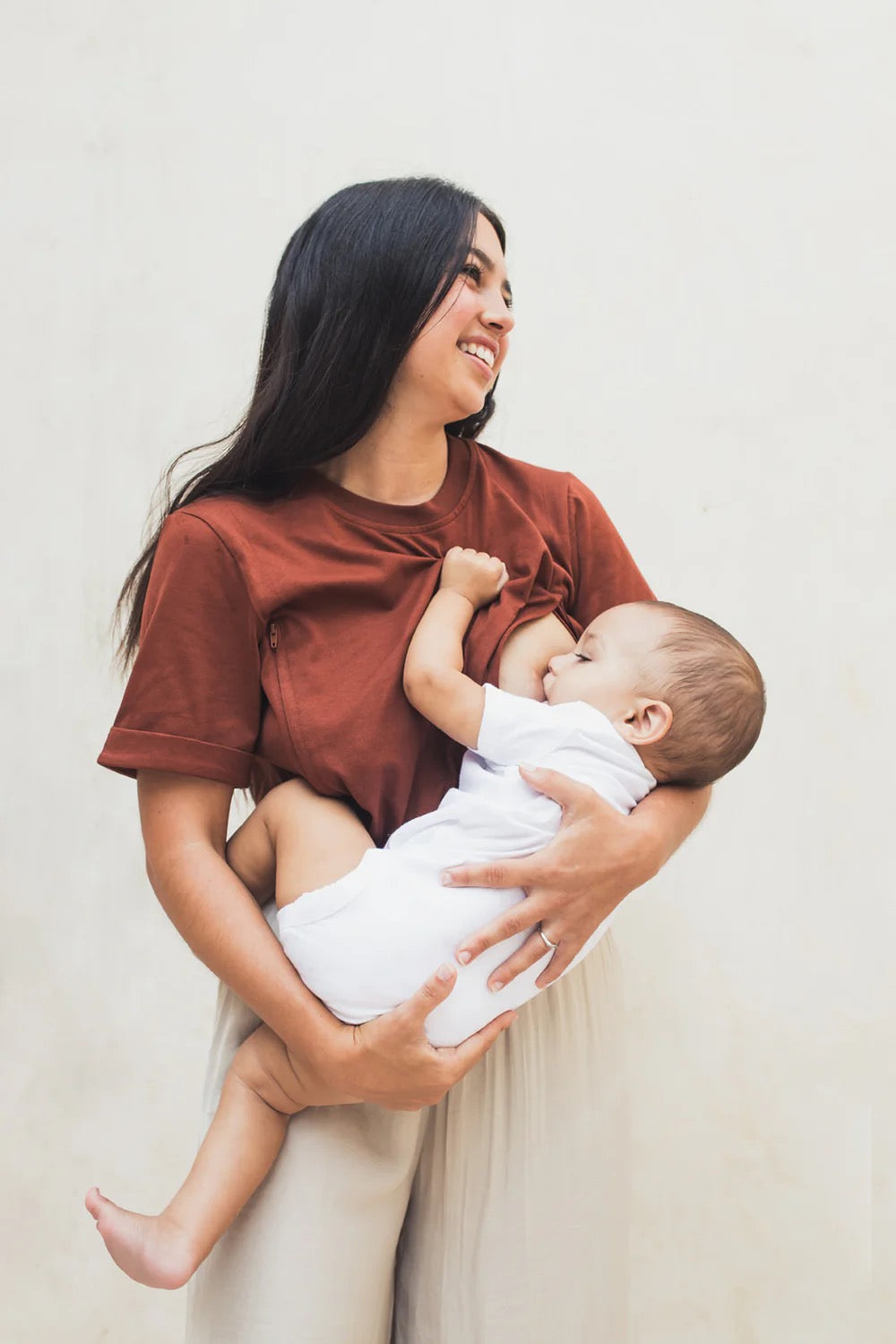
To simplify your daily life during this period, discover our practical nursing wear

And what do we moms think? ?
What a difference it makes when dad is there
We know, because we live it: the father's presence from the start changes absolutely everything.
When it's there, really there:
-
We feel supported,
-
We no longer all alone,
-
We between feeds,
-
We weep less from fatigue,
-
We laugh a little more,
-
We feel simply... accompanied.
It's amazing how a few days can change a life. And yet, many fathers don't dare put their days aside. For fear of being judged, pressure at work, or just because they don't know quite how.
That's why we talk about it. To normalize. To raise awareness. To encourage.

What we'd like for the future
What's expected to change tomorrow
We dream of paternity leave that allows all couples to experience the early days together, really together.
Leave designed for the "real thing": the dark circles, the feeds, the doubts, the cuddles, the sleepless nights and the little moments of magic.
A vacation that recognizes that the arrival of a baby is not just a matter for mothers.
That it's a story for two (or more), right from the start.
Because we all know: postpartum isn't just a sweet time. It's a tsunami.
And a tsunami is best experienced by two people.
 Why don't fathers always take time off?
Social and professional pressures hold them back
It's a question moms often ask each other:
"But why hasn't your partner put down all his days?"
And the answers are almost always the same:
-
"His manager wasn't thrilled..."
-
"He had a big project on the go."
-
"In his company, no one takes the time off."
-
"He was afraid it would give a bad image."
We see this pressure coming from afar. We sometimes even feel it for ourselves, so imagine what it's like for fathers: they're asked to be present at the birth... but also available at work, efficient, invisible in their role as young dads.
The result?
Many take only a portion of their days off.
Others take them, but feel guilty.
And some don’t even dare to ask for them.
The problem is that this hesitation creates a huge imbalance in how families experience those first few weeks. Because while one person hesitates, the other (often us moms) ends up taking on everything with no choice in the matter.
What this means for the baby (and why it's important)
A father's presence is a real benefit for the infant
We hear a lot about ourselves, but paternity leave is also a gift for the baby.
Studies show that :
-
The father's presence reduces the infant's stress,
-
Reinforces attachment,
-
Improves sleep,
-
And even the future division of parental tasks.
In other words: this leave is an emotional investment for life.
And let's face it, babies don't need perfect parents. He needs two parents present. Available. Not running between meetings or feeling guilty about not being at work.

So, where are we headed?
Attitudes are changing, but there is still much work to be done
You can see it: it's moving. Slowly, but it's moving.
More and more workplaces :
-
Encourage fathers to take their leave,
-
Train managers to meet these challenges,
-
Standardize the idea that yesfamily sometimes comes before Excel.
And society is changing too: today, it's more valued to be an involved father than one "who never misses a day's work".
But there's still a long way to go. A long way.
We dream of paternity leave that is no longer just a "bonus", but a pillar of the postpartum period. post-partum pillar.
Leave that's long, accessible and taken for granted.
Leave that allows families to start out on a smoother, fairer, more balanced footing.
Because, let's be honest, being two in the chaos of the early days changes everything.
And to accompany these first moments of relaxation, discover our maternity and nursing collection designed for new parents.

If you're looking for the perfect gift for a breastfeeding mom, here are our collections: