Breastfeeding and Colds in Winter: What Breast Milk Really Does for Your Baby
Breastfeeding and Colds in Winter: What Breast Milk Really Does for Your Baby
Winter is coming, and with it comes a host of viruses, runny noses, and restless nights. And when your baby gets sick for the first time, the question inevitably arises: Should I keep breastfeeding? Is my milk good for him? Am I at risk of passing something on to him?
The short answer: Yes, keep going. And yes, your milk is doing him a world of good—much more than you can imagine.
Here's what science says about breast milk and a baby's immunity in winter, explained simply and without medical jargon.
Breast milk isn't just food
This is the first thing to understand. Breast milk is a living fluid. Its composition changes with every feeding, at every hour of the day, depending on the baby’s age and, above all, on the baby’s health.
When your baby is sick, your milk adapts. Studies have shown that the concentration of white blood cells in breast milk increases significantly when your baby has a cold or an infection. Your body detects your baby’s illness through their saliva when it comes into contact with your breast during a feeding and sends immune reinforcements directly into your milk.
It is an extraordinary mechanism that no infant formula can replicate.

Antibodies: The Immune Shield in Breast Milk
Breast milk is rich in immunoglobulins, particularly secretory immunoglobulin A (IgA). These antibodies line the mucous membranes of a baby’s nose, throat, and intestines, forming a protective barrier against viruses and bacteria.
In practical terms, when you come into contact with a virus—such as the rhinovirus that causes the common cold—your immune system produces specific antibodies against that virus. These antibodies pass into your breast milk and protect your baby against that exact same virus.
In the winter, when you’re exposed to many infectious agents, your breast milk becomes a veritable cocktail of antibodies tailored to the environment in which the two of you live.
What Else Is in Breast Milk to Protect Your Baby?
Antibodies aren't the only defenders in your milk. Here are the main immune components that help your baby when he or she has a cold.
Lactoferrin
Lactoferrin is a protein naturally present in breast milk, found in particularly high concentrations in colostrum and during illness. It works in several ways: it deprives bacteria and certain viruses of the iron they need to multiply, it strengthens the natural defenses of the mucous membranes, and it has a direct anti-inflammatory effect.
Human Milk Oligosaccharides (HMOs)
These complex carbohydrates do not directly nourish the baby; rather, they nourish the good bacteria in the baby’s gut. A healthy gut microbiome is directly linked to a strong immune system. In winter, this prebiotic effect of breast milk is particularly valuable.
Cytokines
These signaling molecules help regulate a baby's immune response. They help the baby defend against infections without triggering an excessive inflammatory reaction, which is particularly important for very young children whose immune systems are still immature.
Stem Cells and White Blood Cells
Breast milk contains living cells—including macrophages, lymphocytes, and even stem cells—that pass directly into the baby's body during breastfeeding and play an active role in the baby's immune defense.

Why You Should Definitely Not Stop Breastfeeding When Your Baby Is Sick
This is a mistake many moms make out of a desire to do the right thing: they think that if their baby is sick, it’s better to give him or her infant formula so as “not to tire him or her out even more.” It’s actually the exact opposite.
When a baby has a cold, he or she needs breast milk more than ever for three key reasons.
The first is hydration. A cold dries out the mucous membranes, a fever causes sweating, and a baby can quickly become dehydrated. Breast milk is 88% water and adapts by becoming even more hydrating at the start of a feeding when the baby has a fever.
The second is comfort. When a baby is sick, he or she feels uncomfortable, is in pain, and feels lost. Breastfeeding is a powerful natural soothing agent—the skin-to-skin contact, the warmth, the familiar taste of milk, and the oxytocin released during feeding. It is the best natural pain reliever there is for an infant.
The third is active immunity. As we’ve seen, your milk is producing specific antibodies against the virus affecting your baby. Stopping breastfeeding at this very moment would deprive your baby of its best defenses just when it needs them most.

What if you're the one with a cold?
This is the question most moms ask themselves: If I'm sick, is there a risk that I'll pass the illness on to my baby while breastfeeding?
The answer is no—in fact, the opposite is true. When you have a cold, your body produces antibodies against the virus in question. These antibodies pass into your breast milk within the first few hours of infection, often even before you experience the first symptoms. Your baby therefore receives real-time immune protection, tailor-made to fight the virus to which you are both exposed.
Respiratory viruses, such as the rhinovirus that causes the common cold, do not pass into breast milk. The virus spreads through the air or by direct contact—wash your hands thoroughly before feedings, and avoid kissing your baby on the face if you have severe symptoms. This is usually enough.
Keep breastfeeding, even when you're sick. It's the best gift you can give your baby.
A baby with a cold isn't feeding as well: what should you do?
This is often the practical challenge of a winter cold: the baby has a stuffy nose and has trouble breathing while nursing. The baby pulls away, cries, and gets frustrated. Feedings become difficult for both of you.
A few tips to make breastfeeding easier when your baby has a cold.
Clear your baby's nose right before feeding using saline solution and a nasal aspirator. A clear nose means a smooth feeding.
Choose semi-upright positions that help your baby breathe more easily while nursing, such as the "football hold" or the slightly reclined face-to-face position.
Shorten feedings if your baby gets tired, but increase their frequency to keep your baby hydrated and ensure they continue to take in milk.
Humidify the air in the room with a humidifier or by running hot water in the bathroom before feeding; the moist air helps clear the mucous membranes.
Breastfeed in a quiet, low-stimulus room so your baby can focus on feeding despite feeling uncomfortable.
What Breast Milk Can't Do
Let's be honest: breast milk is amazing, but it's not magic. It doesn’t cure a cold on its own and isn’t a substitute for a doctor’s visit if your baby is very young (under 3 months), has a high fever, refuses to feed for more than 6 to 8 hours, has trouble breathing, or seems very lethargic.
Breast milk reduces the duration and severity of infections, strengthens the immune system over the long term, and provides comfort and hydration; however, if you have any concerns, always consult a doctor or pediatrician.
Winter, Breastfeeding, and Long-Term Immunity
One point that is often overlooked: the immune benefits of breastfeeding do not end when the baby stops nursing. They continue well beyond weaning.
Children who have been breastfed have statistically fewer respiratory infections, fewer ear infections, fewer hospitalizations for bronchiolitis, and a reduced risk of developing certain chronic diseases. These benefits are proportional to the duration of breastfeeding—every week counts.
By continuing to breastfeed during tough winters, you're not just fighting this week's cold. You're building your baby's immune system for years to come.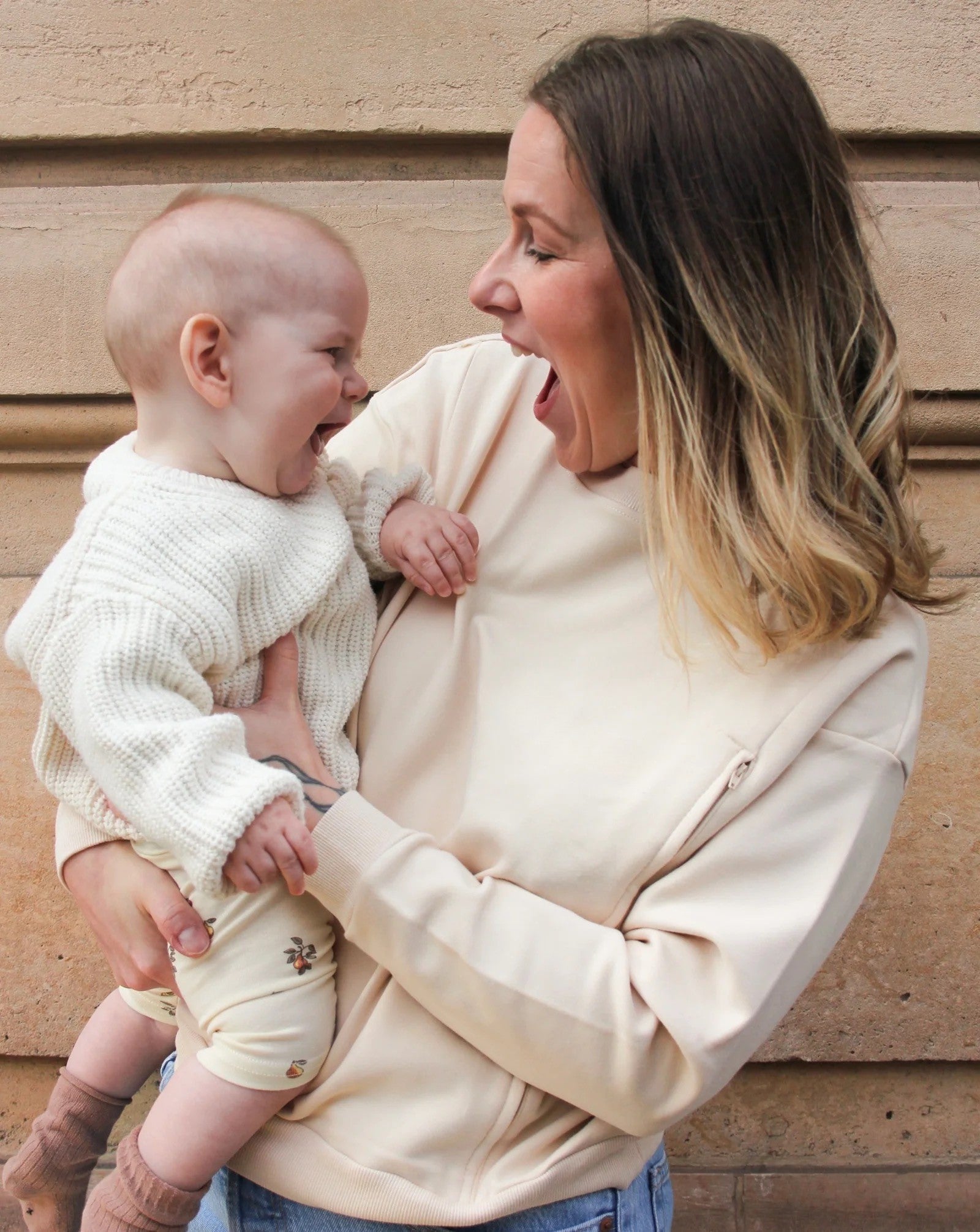
In summary: How breast milk helps babies with colds in the winter
| What's in Breast Milk | What It Means for a Sick Baby |
|---|---|
| IgA Immunoglobulins | Protect the mucous membranes against viruses |
| Lactoferrin | Inhibits the growth of bacteria and viruses |
| Live white blood cells | Actively protect the baby's body |
| Oligosaccharides (HMO) | Nourish the microbiome and boost immunity |
| Cytokines | Regulate the inflammatory response |
| 88% water | Hydrates and replenishes fluids lost due to fever |
When your baby has a cold this winter, the best thing you can do is keep breastfeeding. Your body knows exactly what your baby needs and produces it in real time, feed after feed.
To breastfeed comfortably in winter—even on chilly days when you're stuck at home—check out our Breastfeeding sweaters in knit and our nursing sweatshirts Designed for stay-at-home moms who don't want to compromise on comfort or style.